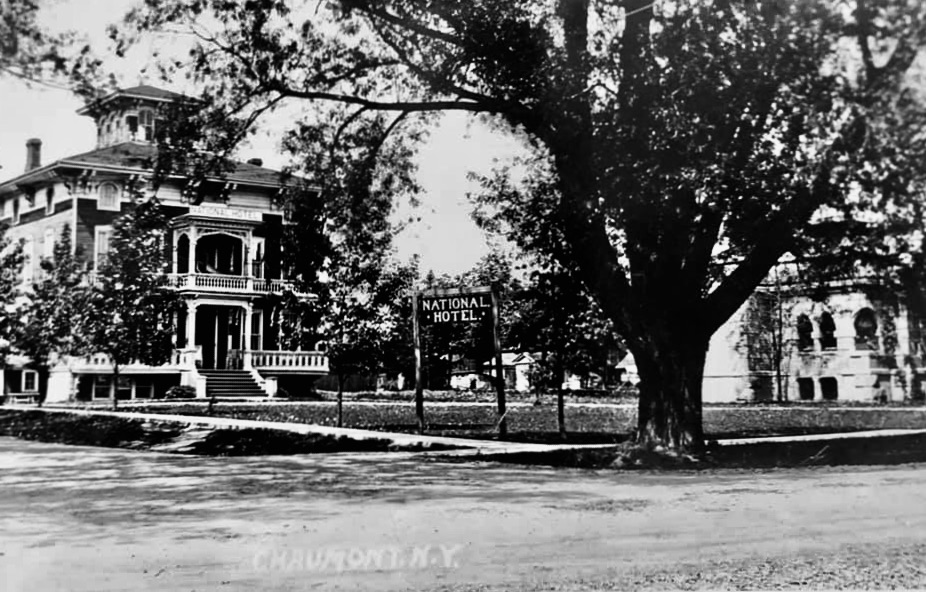
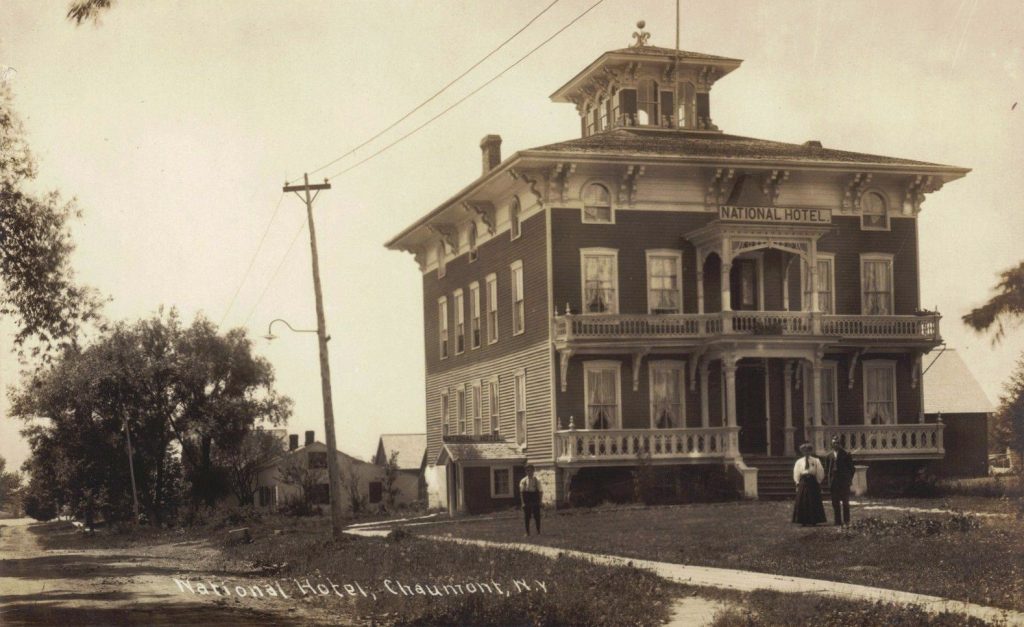
Chaumont Landmark For Many Years, O. S. Wilcox Residence Became National Hotel Then Carlier Hotel In Later Years
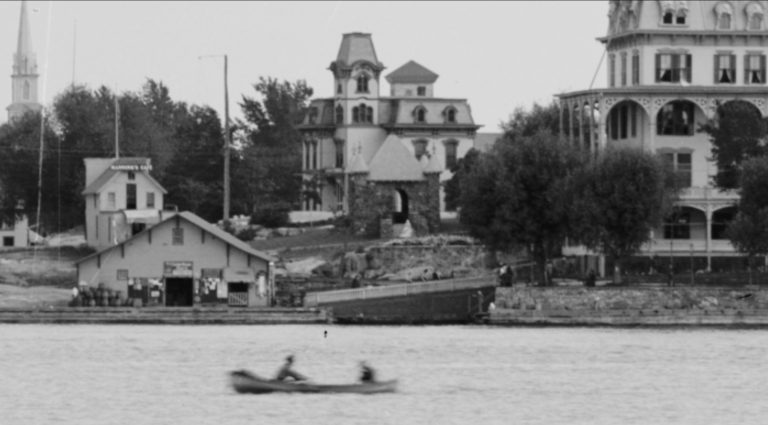
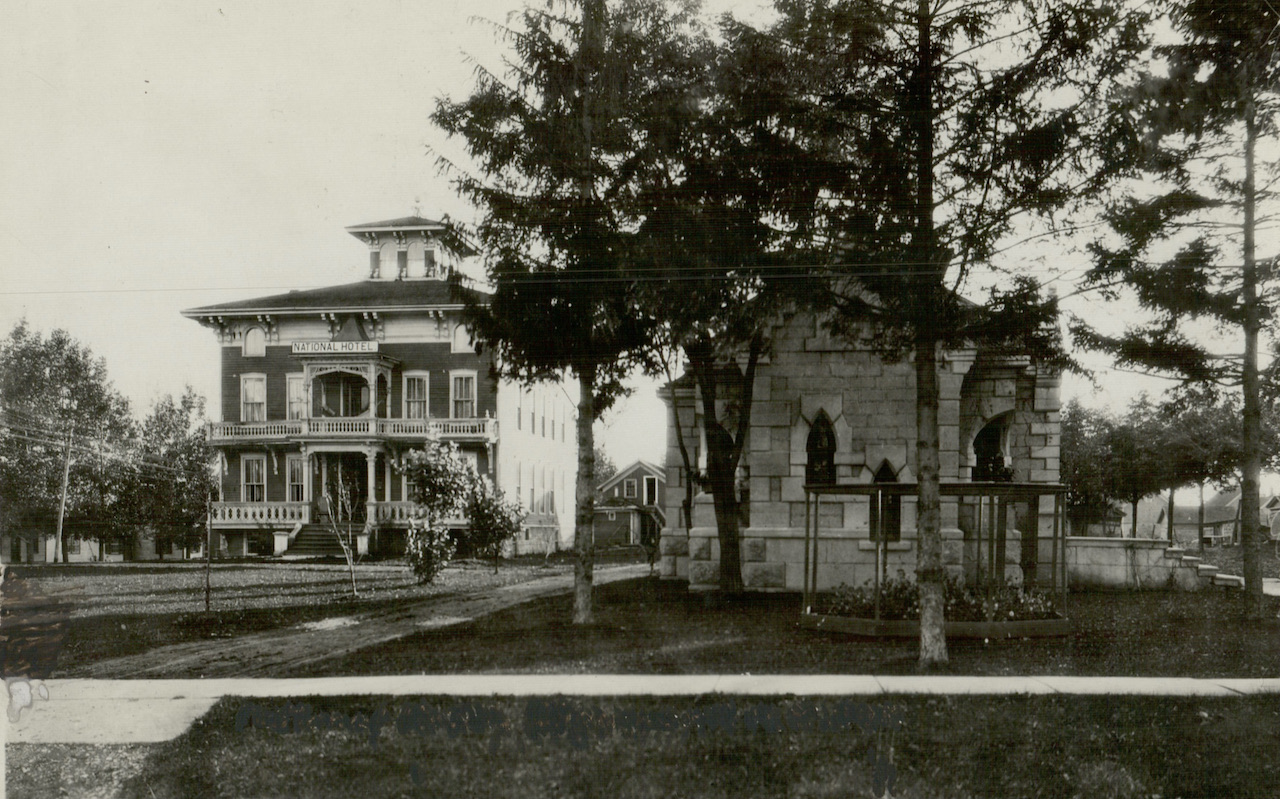
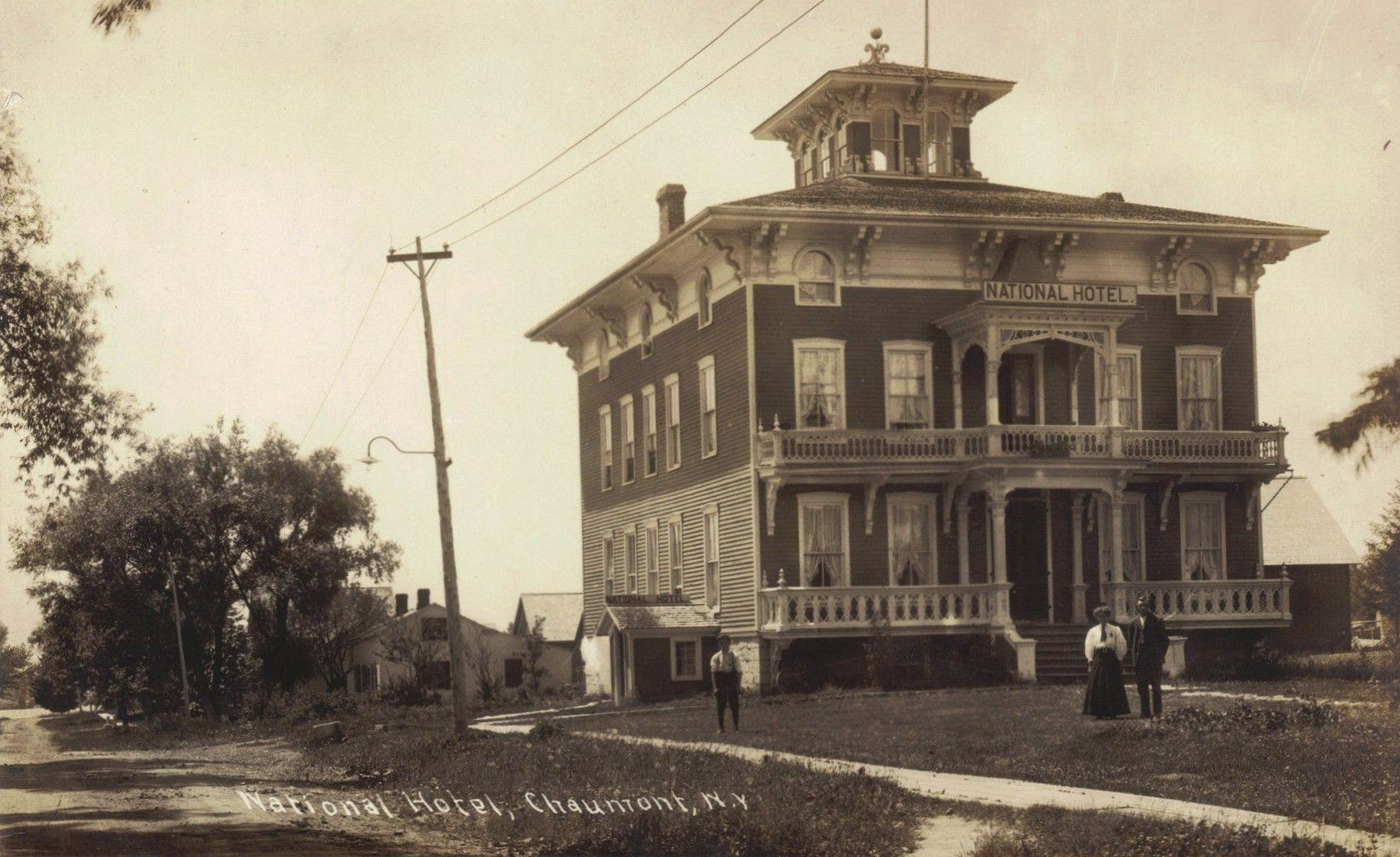
Oren Schuyler Wilcox, O. S. Wilcox herein, began construction on the Wilcox residence, later the National Hotel, on a Monday in June of 1873 with the digging of the cellar to his new house. On the corner of Main and Madison Street, the lot would be right next to the Hiram Copley building made of limestone, serving as the office showcasing their limestone business.
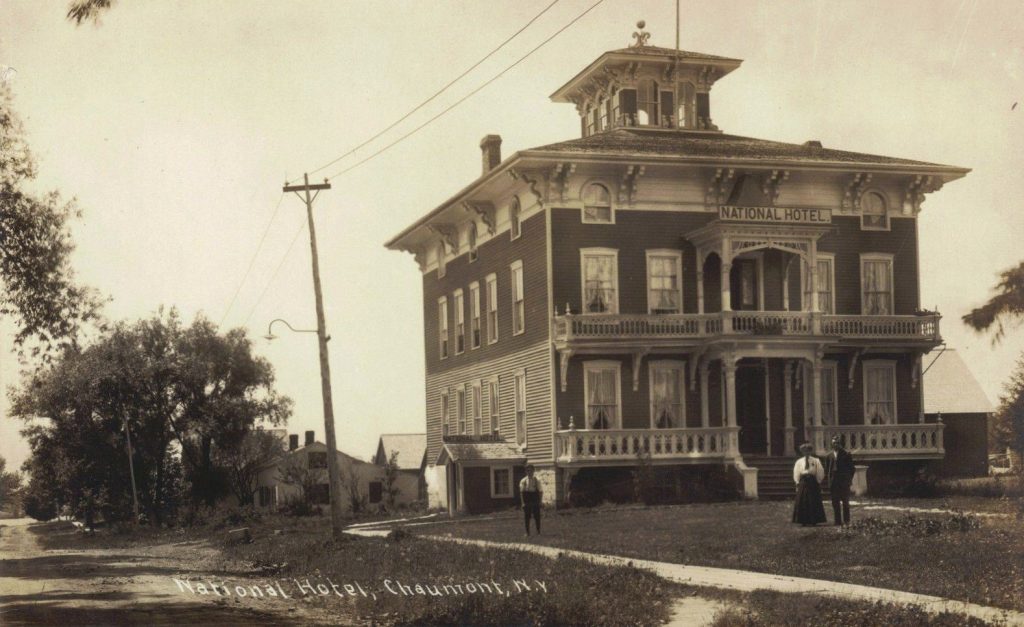
On December 1, 1873, The Watertown Daily Times reported–
O. S. Wilcox has nearly completed a commodious residence on the corner of Main Street and Madison Avenue. It is 50 by 40 feet, 2 1/2 stories high, with observatory. The wall of the cellar or basement is of blue limestone and 2 1/2 feet thick. The first, second, and third stories are 10, 11 and 7.5 feet between joints respectively, and the windows of the best French glass, 40 by 16 inches, four panes to the window.
It was also stated that the cost of the Wilcox residence would be over $7,000 upon its completion. He planned to open a grocery store in Chaumont, but it wasn’t successful. In July of 1877, the Times would state he was planning to remodel his large residence into a hotel with plans to open it the following year. It’s unknown if he went through with his plans at that time because he ended up forming a partnership, Wilcox and Dewey, which sold dry goods and clothing.
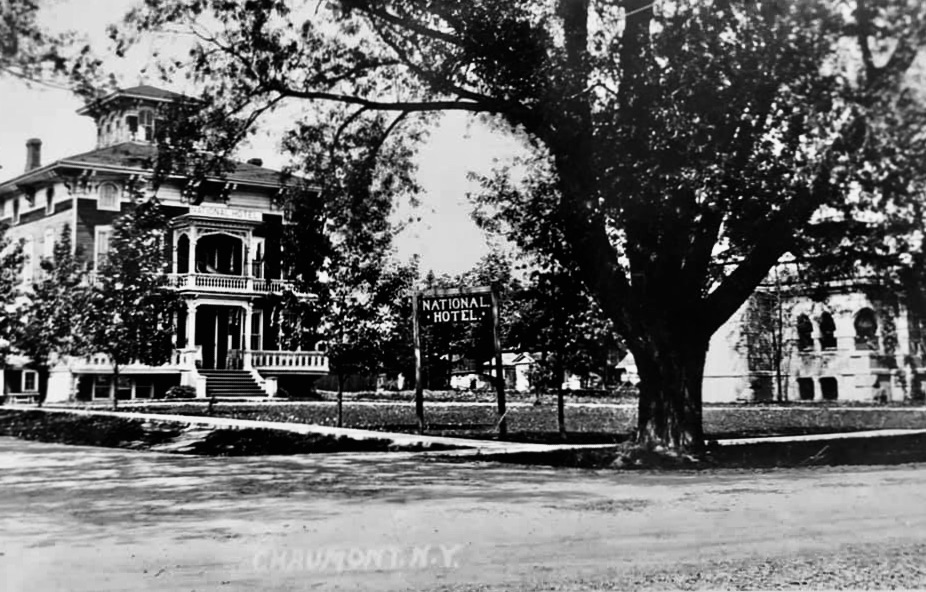
At some point around 1888, the Wilcox residence would become the National Hotel – a true nightmare for researchers as every place seemingly had a National Hotel, whether big or small, during the era. A brief passage in the Daily Times noted a new National Hotel in Jefferson County that year, while two years later associating it with Clark Wilday. The venture must have lasted less than a decade, for in 1896, it would be leased by L. Crouse, formerly proprietor of the Peck House in Chaumont, who would place ads in the Watertown Daily Times letting patrons know that, although changing its name to the Crouse Hotel, they intended to keep a first-class place in every respect.
In the years after, the building would change ownership numerous times, most notably to Grace Adams, who would reside there, but in earlier years operate it as the Venture Inn dating back to 1921 when Miss Adams purchased the National Hotel from William Allison of Dexter when she renamed it.
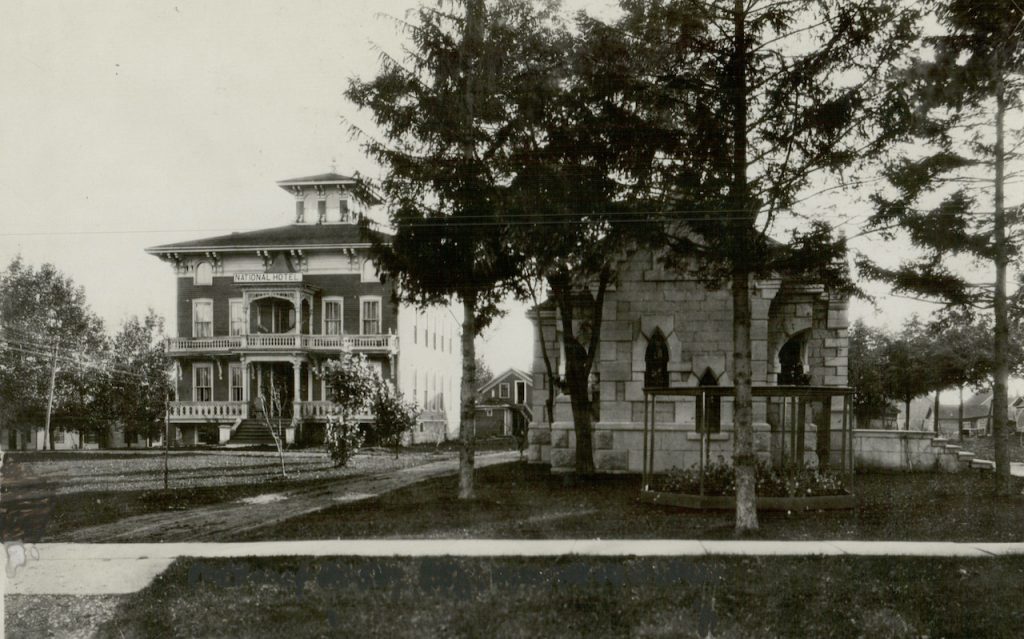
In 1945, the former Venture Inn and Grace Adams residence would be sold to Mr. and Mrs. G. Maurice Carney and Mr. and Mrs. John Bourlier, which the Watertown Daily Times reported, “the building, the former residence of Mrs. Grace Adams, was converted to a hotel in 1945 by the Carneys,” which implies Miss Adams, as she had always been referred to prior, had, at one time, stopped running it as an Inn. The new owners would proceed to rename it the “Carlier Hotel,” taking the first three letters of the Carney last name and combining it with the last four letters of the Bourlier name.
March 31, 1957, Fire
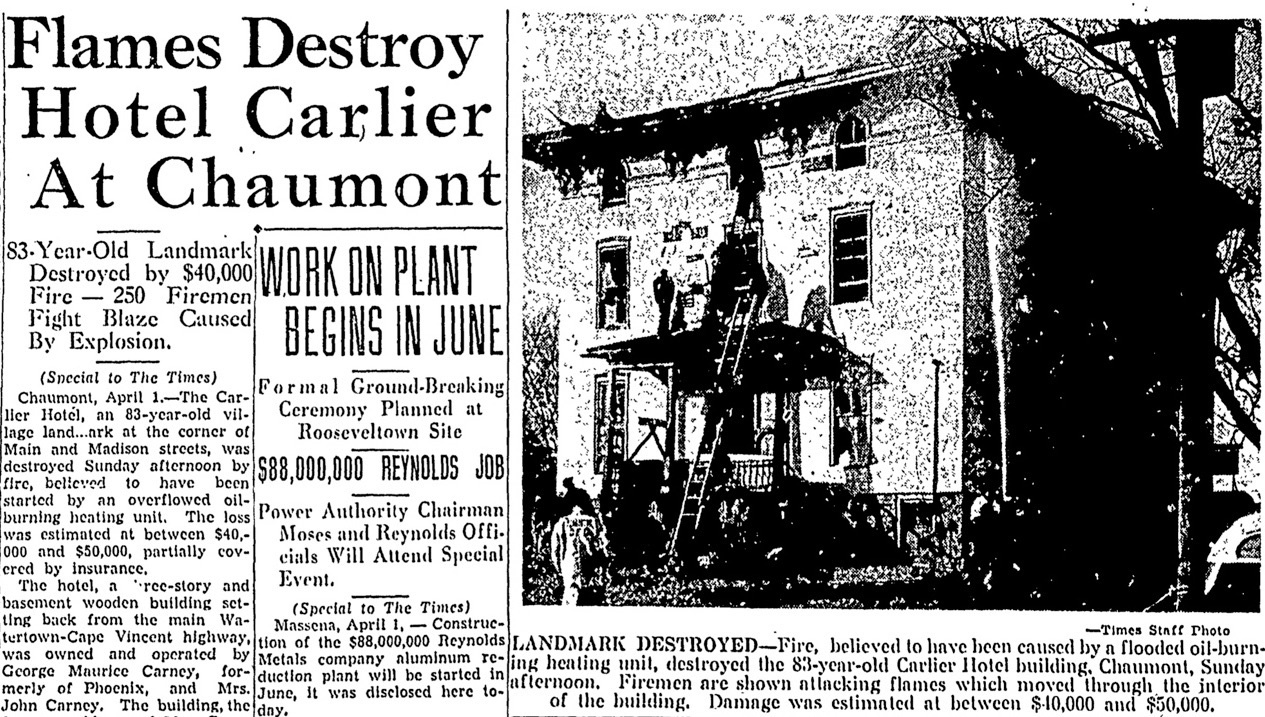
On the afternoon of March 31, 1957, a fire destroyed the Chaumont landmark. An employee arriving to his job as a bartender, Leo Bourn, father of Deputy Fire Chief Victor Bourn, discovered the fire just after 1 p.m. 250 firemen would fight the blaze caused by an explosion, the Watertown Daily Times would report–
The Carlier Hotel, an 83-year-old village landmark at the corner of Main and Madison Streets, was destroyed Sunday afternoon by fire, believed to have been started by an overflowed oil-burning heating unit. The lost was estimated at between $40,000 and $50,000, partially covered by insurance.
Only a shell of a building remained standing today in the aftermath of the fire which raged for more than four hours before being brought under control at 5:30 Sunday afternoon. An estimated 250 firemen from twelve volunteer fire departments battled the stubborn blaze which moved from the basement through partitions to break out at the roof.
It was said that the heat from the flames was so intense the glass from the cupola burst, sending pieces of glass flying about. The Times would further report that the blaze would start anew overnight with a shift in the wind, but a crew from the Chaumont department was on guard, and the fire at the top of the building was quickly extinguished.
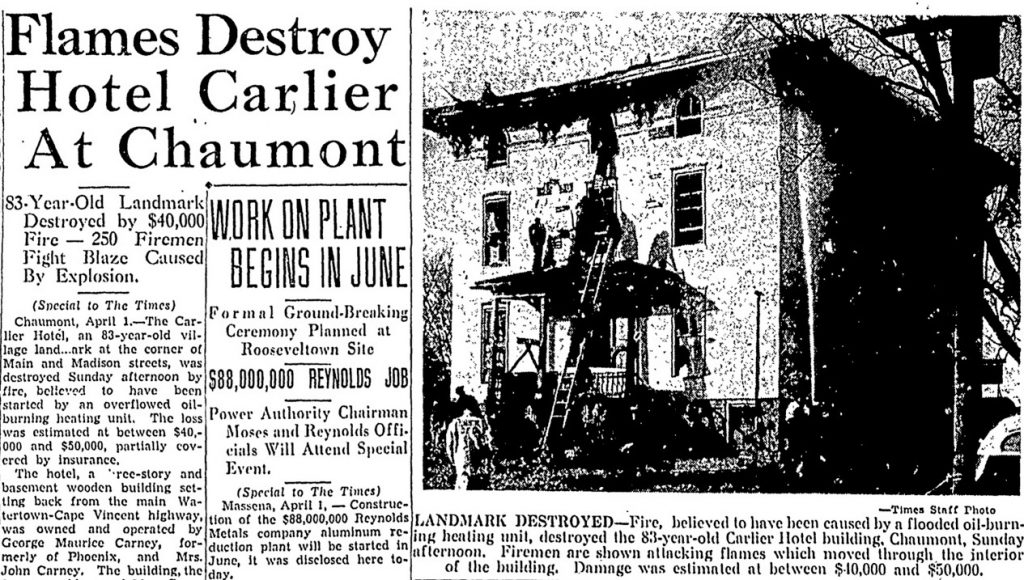
At that particular time, the Daily Times reported the Carlier Hotel as having “a bar and lounge in the basement, two dining rooms and kitchens on the main floor, six bedrooms for guests on the second floor, and living quarters for Mr. Carney on the third floor.”
Rather than rebuild the hotel, the owners would construct a new restaurant with the same name. Carlier Restaurant would open in 1958. In 2006, the restaurant would become The Blue Heron, owned and operated by Cari Greene, who worked at Coleman’s Corners and the Fairgrounds Inn in Watertown, both owned by Leo Coleman, who would give the Salmon Run Mall its first sit-down eatery, the popular Barkeaters, several years after Ground Round and O’Toole’s left in 1993.
And that little castle made of limestone next door? It’s still there and is now called the Chez Heron Bed & Breakfast. You can visit them here and see some interior photos and the accommodations they offer.
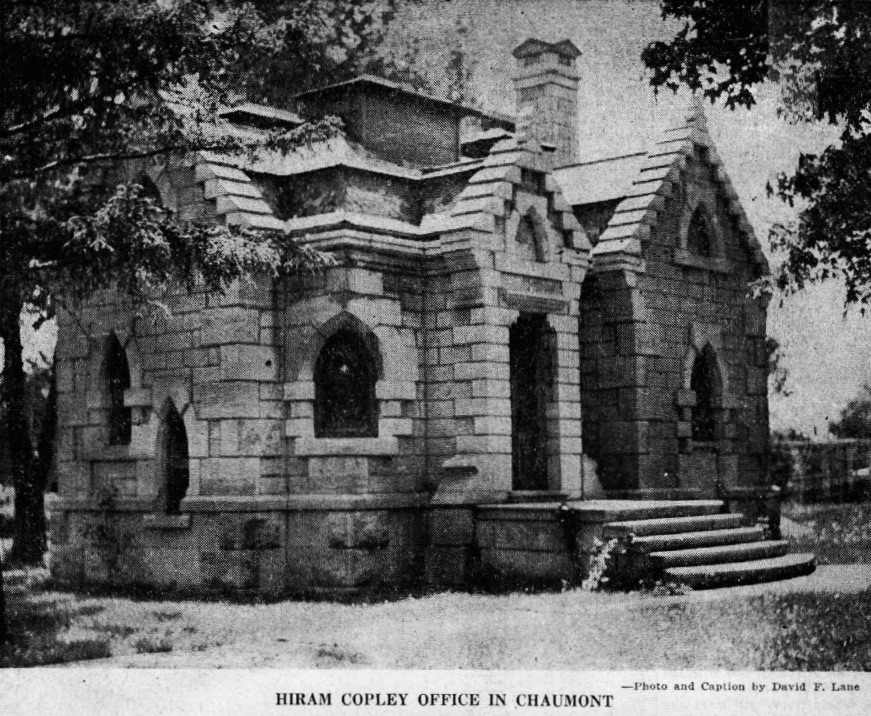
From the David Lane article, Old Houses of the North Country, No. 656—
Copley was once a big name in the lumber and limestone industries of northern New York, especially in Jefferson County, and the above chapel-like building, erected by Hiram Copley, probably in the early 1870s, of native Chaumont limestone, is a monument to the Copley name. It is now the residence of Mrs Bertha M McFarlane, formerly of this city and, widow of Dr. W.S. McFarlane. However, it has had many uses, for many years having been the office building of The Chaumont Company and of Adams & Duford Company, both huge limestone and lime enterprises, but originally it was likely a chapel, which history says Hiram Copley built in Chaumont.
The founder of the Copley industries was Alexander Copley, born September 10, 1805, in Denmark, Lewis County, son of William and Hannah Hand Copley and descendant of Thomas Copley of Springfield, Massachusetts. After a year in Lowville academy, Alexander clerked in Felts Mills stores, became a partner of Jason Francis, sold his store interest to Francis St. Butterfield, became a partner of John Felt and William Coburn in the lumber trade, owned 10,000 acres of Antwerp timberlands, October 30, 1833, married Lucy, daughter of Charles Kelsey of Antwerp, and removed to Chaumont where he had bought 2,502 acres of Vincent LeRay, acquired a house, store, saw and grist mills of William Clark, three years later purchased 10,961 more acres of Gouverneur Morris, engaged in shipbuilding, became a Union bank director and accumulated a large fortune (yes, that really was one sentence!). He died February 5, 1871. He was a supervisor 1843-1818-18.
His son, Hiram, born at Chaumont in May 1831, graduated from Rensselaer Polytechnic Institute, married Mary, daughter of Gaylord Enos of Depauville, took over his father’s town of Lyme properties in April 1871, operated a number of quarries and lime kilns, was village president in 1876 and a founder and director of the Alexandria Bay Steamboat company.
Hiram, with his sons, Allen E. and George W. Copley, incorporated The Chaumont Lime and Stone Company on March 2, 1894, and changed the name to The Chaumont Company on June 1, 1896. George W. was village president in 1886 and Allen E. was in 1895. On July 17, 1891, Hiram sold his properties in Brownville, Clayton, and Lyme to Allen and George, including the above building, for $150,000. They conveyed them for 13,000 to The Chaumont Lime & Stone company, April 9, 1894, including the above building.